
If you’re planning a new driveway or patio, “permeable” vs “non permeable” can sound like a technical detail.
In reality, it often decides whether you end up with puddles, slippery algae patches, or water running where you do not want it.
It can also affect how much groundwork is needed, how the area copes in winter, and how much maintenance you will tolerate long term.
The good news is you do not need to be an expert. You just need to understand how water will behave on your property.
This guide breaks it down in plain English and helps you choose a surface that suits your home, your budget, and Yorkshire weather.
Quick definitions
What “permeable” means
A permeable surface allows rainwater to pass through the finished layer and soak into a properly prepared base beneath.
Done well, it reduces standing water and takes pressure off the surrounding drainage.
What “non permeable” means
A non permeable surface does not let water through, so rainwater runs across it instead.
That run off needs a sensible route away, which usually means correct falls (the slope), plus drainage channels or soakaway solutions where needed.
Why homeowners mix them up
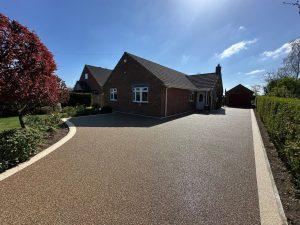
Some finishes look like they should drain, but the way they’re installed can change everything.
For example, block paving can be permeable with the right system, or effectively non permeable if it’s laid and jointed in a traditional way.
Looks help, but performance comes from the build underneath.
The real world differences you’ll notice day to day
- Puddles after rain: Permeable builds can reduce pooling, but only if the base and ground can cope with the water.
- Slippery patches: Shaded areas dry slower. Poor drainage can encourage algae and moss, whatever the surface type.
- Drying time: A well designed surface with sensible drainage tends to dry faster, which matters when temperatures drop.
- Where the water goes: Non permeable surfaces can behave perfectly… right up until water is forced towards your door, garage, or neighbour’s boundary.
Permeable vs non permeable: simple comparison
| Factor | Permeable surfaces | Non permeable surfaces |
|---|---|---|
| Drainage handling | Water passes through into the base | Water runs off and must be directed safely |
| Groundwork | Base build is critical for soak through performance | Falls and drainage design do the heavy lifting |
| Maintenance | Usually low fuss, but keep it clean so pores do not clog | Often straightforward, but drains and channels must stay clear |
| Winter performance | Less standing water can mean fewer icy puddles | Fine if water is managed well, risky if pooling occurs |
| Repairability | Depends on material, but local repairs are often possible | Often easy to repair if the base remains stable |
| Best for | Areas prone to pooling, limited run off routes, flatter sites | Sites where you can design falls and drainage with confidence |
When permeable surfaces make the most sense
Permeable surfacing tends to suit homes where water already feels like a problem.
If your drive turns into a shallow pond after a downpour, or you are sick of water tracking towards the house, it is usually worth exploring a permeable option.
- Flat or low lying areas where water lingers
- Driveways with no obvious safe run off route
- Front garden conversions where drainage becomes the key question
- Homes where you want a cleaner look without constant puddle management
Just keep one thing in mind: permeable does not magically fix everything.
If the ground below is heavy clay and already saturated, the base still needs to be designed properly so water can disperse rather than sit.
When non permeable surfaces can still be the better choice
Non permeable does not mean “wrong”. It simply means you need a plan for where the water goes.
In some situations, a non permeable surface with properly designed falls and drainage is the most sensible option.
- Sloped driveways: run off can be controlled and directed to the right place
- Sites with room for drainage solutions: channels, gullies, or soakaway options can be built in
- Specific finishes: some patio and paving choices are commonly installed as non permeable
- Budget reality: sometimes it’s better to do a strong build plus drainage than compromise on the base
The key decision factors
1) Your soil type
Many properties in our region sit on clay rich ground that drains slowly.
That does not rule out permeable surfacing, but it does mean the base build and drainage strategy matter more than the finish you can see.
2) The slope and where water currently goes
Walk outside next time it rains and look for natural low points.
If water already runs towards the house, a non permeable surface without the right falls can make that worse, quickly.
3) The size of the area
Bigger driveways collect more water. A small patio puddle is annoying; a large driveway holding water becomes a real issue over time.
4) Vehicle use and load
Daily parking, vans, turning circles, and wheel spin spots all put stress on the surface and the base.
If the foundation is weak, even the nicest finish will suffer.
5) Your maintenance tolerance
Be honest here. Will you sweep it now and then, keep drains clear, and deal with edges?
If not, choose the option that stays tidy with minimal input.
6) The look you’re aiming for
Colour and texture can hide everyday marks better than people expect.
Very pale finishes look stunning, but they show more. Dark finishes can look sharp, but may show dust.
There’s no perfect answer, just a sensible trade off.
Common myths
- “Permeable means it never floods.” It helps, but if the base or ground cannot take the water, you can still get issues.
- “Non permeable is always cheaper.” Not if you later need drainage work to fix pooling or run off problems.
- “It’s the surface that matters most.” The foundation, falls, and drainage design often decide whether a driveway lasts.
What about planning permission and drainage rules?
 This is the part people put off, then regret later. In many cases, especially at the front of a property, you may need to consider how surface water is managed.
Rules can vary by area and site, so it’s worth checking local guidance and choosing an installer who builds with drainage in mind from day one.
If you want a quick primer, have a look at our approach to
SuDS compliance,
which is all about managing surface water sensibly rather than hoping it will sort itself out.
Surface options to consider
Resin bound surfacing
Resin bound is a popular choice because it can deliver a smooth, clean finish and, when installed correctly, it is often chosen for its drainage performance.
See our resin bound drives, paths and patios service for examples.
Block paving
Block paving can be installed in different ways depending on the system used.
It’s flexible in design, strong under vehicles, and repairs can be tidy if done properly.
Explore block paving driveways and surfacing.
Porcelain and exterior tiling
Porcelain patios look sharp and are hardwearing, but they are typically treated as non permeable, which means falls and drainage details matter.
Take a look at porcelain outdoor surfaces.
Tarmac
Tarmac is practical and popular for driveways, especially where you want a neat, durable finish.
It is generally non permeable, so proper drainage design is part of doing it right.
See high quality tarmac surfacing.
A quick decision guide
Choose permeable if…
- Your current driveway pools water or stays wet for ages
- You have limited places for run off to go safely
- The area is relatively flat and you want fewer puddles
- You want a finish that can support better surface water management
Choose non permeable with proper drainage if…
- Your site has a slope that can be designed with sensible falls
- You can include channels or other drainage details as part of the build
- You prefer a finish that is typically installed as non permeable
- You want a simpler surface, but you are happy to keep drainage points clear
Still unsure? That’s normal. A quick site check (looking at slope, soil, and existing drainage) usually tells you more than hours of online reading.
Summary
The best choice is rarely “permeable good, non permeable bad”.
It’s more like: the right surface, with the right groundwork, with the right water management for your property.
Get that combination right and you end up with a driveway or patio that looks great and behaves itself in heavy rain.
If you’d like advice based on your actual site (not generic guesses), First Impressions Yorkshire can recommend the best approach and provide a clear quote and timeline.
Start here: contact us or browse our full range of driveway and landscaping services.